
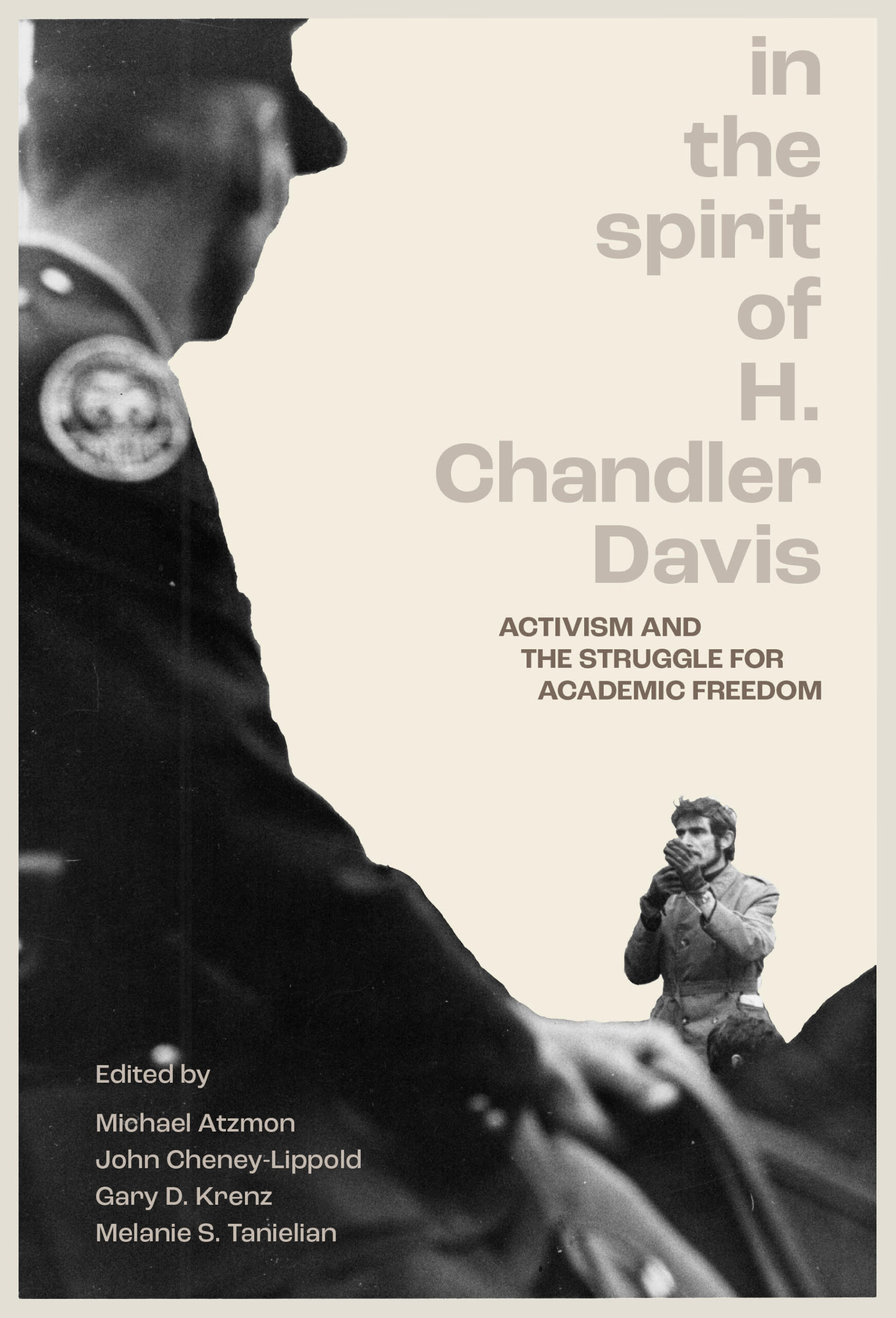
IN THE SPIRIT OF H. CHANDLER DAVIS
BUY IT NOW
book description
The essays collected in this book honor H. Chandler Davis (1926-2022), a University of Michigan faculty member who became a symbol of principled dissent when suspended and fired in 1954 for refusing to testify about his political affiliations to the House Un-American Activities Committee. Invoking academic freedom and First Amendment protection, Davis was convicted of contempt of Congress. He served six months in prison before moving to Canada, where he established himself as a brilliant mathematician, prolific writer, and ardent and much beloved advocate for justice.
At a time when a new McCarthyism has come roaring back to threaten free inquiry everywhere, the 12 contributors to this book argue against censorship, the suppression of protest, the policed and surveilled campus, the self-silencing of “institutional neutrality,” and other enemies of academic freedom. Also included in this volume is posthumously published work by Davis and by his late wife, the historian Natalie Zemon Davis, which reflects on the importance of facing, and not accepting, authoritarian threats.
Inspired by Chandler Davis’ courage, integrity, and devotion to the struggle against oppression, injustice, and the persecution of speech, these essays offer crucial insights into the importance of defending intellectual independence, institutional autonomy, and the right to free expression.
about the editors
Michael Atzmon is Professor Emeritus of Nuclear Engineering & Radiological Sciences and Materials Science and Engineering at the University of Michigan. His research included experimental and theoretical studies of nanomaterials and metallic glasses. He has been involved with the Davis-Markert-Nickerson Lecture for the past decade.
John Cheney-Lippold is Associate Professor of American Culture and Digital Studies at the University of Michigan. He is author of We Are Data: Algorithms and the Making of our Digital Selves and currently researches and writes on digital technology, power, and culture.
Gary D. Krenz retired recently from the directorship of the historic Judy and Stanley Frankel Detroit Observatory at the University of Michigan. In the course of his career at U-M, he held a number of administrative roles and lectured in philosophy on ethics, particularly ethics of higher education.
Melanie S. Tanielian is an Associate Professor of History at the University of Michigan whose research focuses on war, famine, and humanitarianism in the modern Middle East. She is the author of The Charity of War: Famine, Humanitarian Aid, and World War I in the Middle East and is currently expanding her work to examine the politics of food insecurity and humanitarian response in the region today. Her scholarship bridges past and present to illuminate how societies confront crisis and care.
contributors
Michael Bérubé, Juan Cole, H. Chandler Davis, Stefan Hanß, Marjorie Heins, Dima Khalidi, Gene Nichol, Henry Reichman, Ellen Schrecker, Joan Scott, Catharine R. Stimpson, Alan Wald, Silke-Maria Weineck, and Natalie Zemon Davis.
praise for this book
“This remarkable volume breathes with the spirit of resistance and resilience embodied by the distinguished activist Chandler Davis, whose lifelong commitments of principle offer an inspiring and daunting model to us all as we strive to stand up against today’s official assault on academic and intellectual freedom.”
— Howard Brick, Professor of History Emeritus, University of Michigan
“The arch of the moral university does not bend towards justice of its own accord. It does so because of those who stand and fight the authoritarians and the fascists. Today, when so many are cowering, or worse, capitulating, it becomes important to reflect on those like H. Chandler Davis who continued to demand justice even during the darkest of times.”
— Isaac Kamola, author of Manufacturing Backlash
“Contributors to In the Spirit of H. Chandler Davis are unwavering in their admiration for Davis’s integrity and defense of speech. But they are equally alarmed by the erosion of norms on university campuses today, in red states and blue states alike. “With respect to academic freedom, currently facing an assault unprecedented in our country’s history, those of us in higher education — faculty, administrators, trustees, and students — have been compelled to choose,” the historian Henry Reichman writes in his pointed chapter. “Will we accept our responsibility to defend our profession, our academic freedom, indeed, knowledge itself, or will we choose to capitulate to the assault?”
— Literary Review of Canada, April 2026