
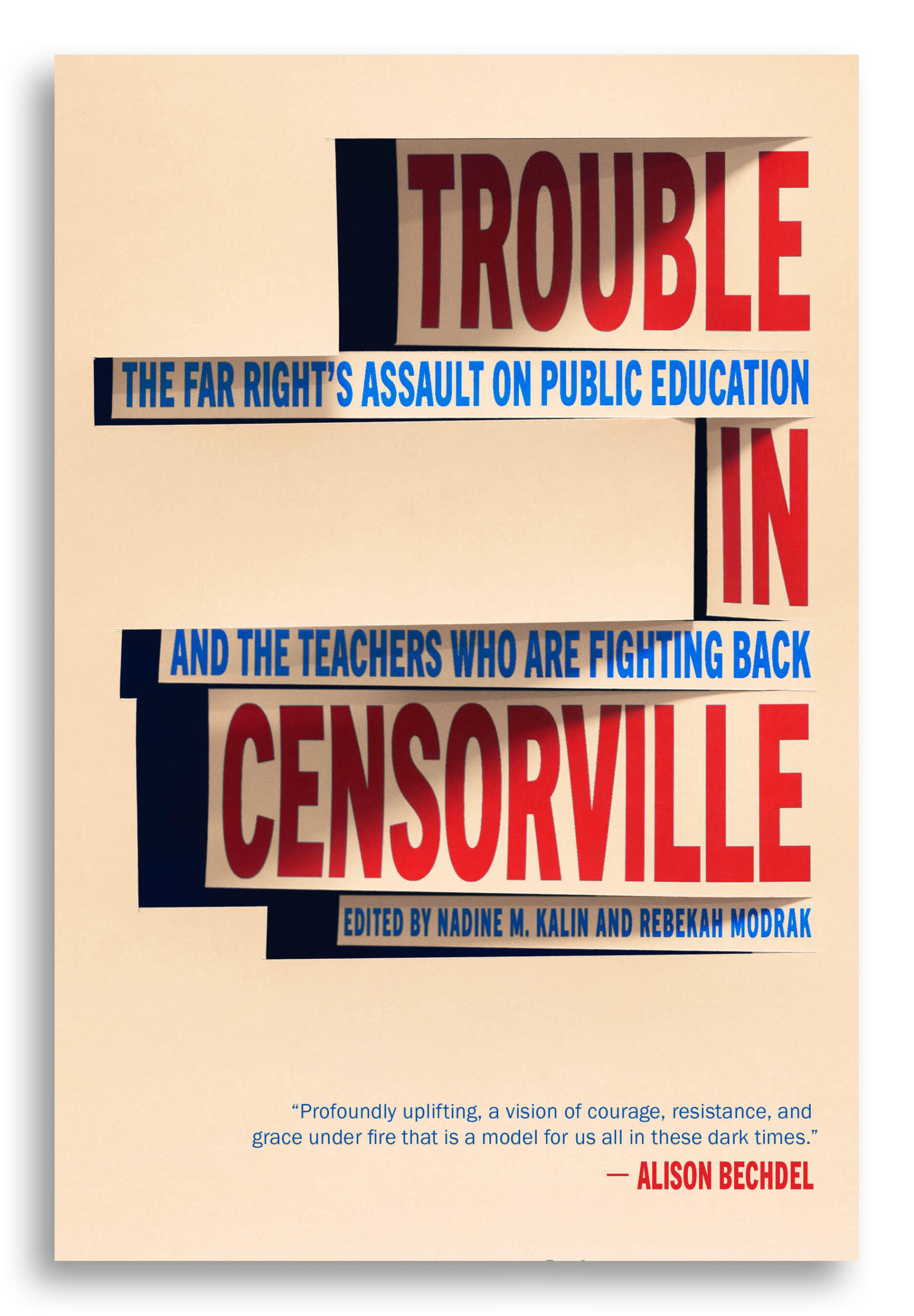
TROUBLE IN CENSORVILLE
BUY IT NOW
book description
From Florida, whose “Don’t Say Gay” law prohibits K-12 instruction on gender identity and sexual orientation, to Texas, which is shuttering libraries in schools whose student bodies are majority Black or Hispanic/Latinx, America is in the middle of a far-right war on public education.
Now, for the first time, K-12 educators from across the nation give readers a teacher’s-eye view of the radical right crusade to take down public education, coordinated by well-funded, well-connected far-right political interests. Christian nationalists hell-bent on erasing the line between church and state, white supremacists opposed to a curriculum that teaches the enduring effects of anti-Black racism, political action committees, such as Moms for Liberty, calling for the banning of novels featuring LGBTQ+ people, and profiteers eager to divert taxpayer dollars into private schools are mounting a relentless attack on teachers, the students they serve, and the commitment to public education that is a cornerstone of democracy. “It’s a phenomenal, unprecedented moment that we’re in,” says a librarian, recently retired from her Texas school. “It’s surprising how many people don’t know what’s going on. I talk to reporters who have no idea. And they’re reporters.
”In Trouble in Censorville, public school teachers from states as far-flung as Florida, Texas, Kentucky, New Jersey, Tennessee, Wisconsin, and Washington describe, in their own words, being threatened, stalked, doxxed, ostracized, smeared as “groomers” and “pedophiles,” placed on leave, and fired for teaching historical truth and racial justice, supporting LGBTQ+ students and, in one case, for wearing “insufficiently” feminine attire. Their stories bring readers face-to-face with the human cost of these attacks, which range from social isolation to pent-up anger over institutional betrayal to the terrible toll on teachers’ mental and physical health.
Teachers are fighting back. They’re mobilizing colleagues, parents, and community members who share their faith in the freedom to read, the freedom to think critically, the freedom to challenge small-minded provincialism. Their stories of frontline resistance, collected here, provide a battle plan for confronting censorship, rallying support, and mobilizing a grassroots defense of public schools.
Their gripping testimonials are enhanced by a timeline that situates today’s far-right war on public education in the context of American History, moving briskly from Reconstruction to the anti-left and anti-gay fear-mongering of the McCarthy era to the Black Lives Matter movement to the Trump presidency. Terrifying, infuriating, and inspiring, Trouble in Censorville sounds the alarm for a democracy on fire.
about the editors
Rebekah Modrak is a Professor at the Stamps School of Art & Design at the University of Michigan. She is an artist and writer who analyzes and critiques consumer culture, including COVID-era privatization of public education as parents began to refer to teachers as “public servants,” subsidized by their tax dollars and therefore answerable to them as consumers.
Nadine M. Kalin is a Professor in the Department of Art Education in the College of Visual Arts and Design at the University of North Texas. She teaches courses in the areas of curriculum and pedagogy, pre-service art teacher preparation, and socially engaged art and is author of the book The Neoliberalization of Creativity Education.
contributors
Ellen Barnes, Willie Edward Taylor Carver Jr., Monica Coles, Gavin Downing, Carolyn Foote, Matthew D. Hawn, Martha Hickson, Jill James, Mark Johnson, Misty L.C., Elissa Malespina, Sally Middleton, Julie Miller, and Melissa Grandi Statz.
praise for this book
“An urgent and compelling battle cry against the insidious rise of censorship. Everyone who believes in freedom of expression should examine this text.”
— Juno Dawson, author of This Book is Gay
“This is easily one of the best, most important books I’ve read this year. … Another thing I loved about this book was hearing from the educators themselves. Here, they control their own stories and share the impact from start to finish, both on their careers and themselves, with no chance for the media to distort or deceive.”
— Sarah Mueller, Teacher and Blogger of All the Book Blog Names Are Taken
“I am so deeply grateful to every teacher and every librarian standing firm against censorship and working to keep my book and others like it on the library shelves. As a queer teen, I desperately needed those books, and the teens of today need them more than ever.”
— Maia Kobabe, author of Gender Queer: A Memoir
“An essential record of the often-invisible war on educators. Moving and inspiring, these stories are a reminder that teachers are on the frontlines of the resistance against authoritarianism. We should join them.”
— Annalee Newitz, author of Stories Are Weapons
“VERDICT: Highly recommended for all public school librarians, teachers, and school administrators.”
— Laura Fields Eason, School Library Journal
“Trouble in Censorville is an urgent bulletin from the teachers and librarians on the front lines of the war agains reason that is sweeping our country. Their powerful testimony is enraging—these vicious attacks are not what they signed up for. But it’s also profoundly uplifting, a vision of courage, resistance, and grace under fire that is a model for us all in these dark times.”
— Alison Bechdal, author of Fun Home
“If you want to know what the attacks on CRT, ‘divisive issues,’ and reading materials have felt like from the inside of a school, or simply want a more complete view of how these culture wars have unfolded in education, there’s much to learn from this book.”
— Peter Greene, Forbes
“Kalin (art education, Univ. of North Texas; The Neoliberalization of Creativity Education) and Modrak (art and design, Univ. of Michigan; Radical Humility) highlight the growing challenges to intellectual freedom in public schools. They provide a succinct timeline of major censorship events in education. Their book gives readers first-person accounts from 14 individuals. Several are award-winning educators whose professional and personal reputations came under fire when they were attacked by far-right groups for addressing topics like race and gender. A couple of themes emerge from their stories: people behind the challenges often do not have children in the districts they target, and organized groups often spread unfounded rumors that the targeted educators are pedophiles or pornographers. As a result, qualified educators are either forced to leave the profession or transferred to positions outside their field of expertise…. VERDICT A timely look at the current state of censorship in American schools and a few ideas to fight against it.”
— Lydia Olszak, Library Journal
“Panic attacks. Debilitating depression. Social isolation. Insomnia, weight gain, hair loss. These are some of the symptoms that 14 public school teachers describe experiencing in Trouble in Censorville, a collection of oral histories that demonstrates the human cost of the campaign against education undertaken by extremists…. But Trouble in Censorville is not a narrative of defeat: the educators it spotlights have garnered support from colleagues, parents, and students, all of whom are fighting back together. The testimonies they share are characterized by resistance and resilience.”
— Julia Goldberg, PEN America